Category: Uncategorized

  • the prince’s person

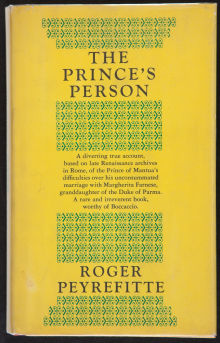
    The Prince’s Person by Roger Peyrefitte (Farrar, Straus & Cudahy, 1965)
    Lf

    I had started this book years ago, but given up too soon — why, I don’t know, because it’s very witty and fun and depraved.

    The Prince of Mantova has a huge cock and his wife has a deformed vagina and so they are unable to consummate their marriage.  It is annulled; she is sent to a convent, and he is affianced to another noble girl, but before he can marry her he must prove his dubious virility by fucking a young woman under observation.  The Vatican is involved in this supposedly true story.    Charming and unique, and Peyrefitte mines it, elegantly, for all it is worth.  A beautiful designed and produced book.

  • the prime minister

    The Prime Minister by Anthony Trollope (Penguin)

    TrollopeThe pentultimate book in the Palliser series, The Prime Minister is a novel with two vaguely intersecting narratives: the first deals with Ferdinand Lopez and his courtship and marriage to Emily Wharton.  He’s a foreigner of dubious birth, possibly Semetic, and possessing indeterminate financial wealth; she is a dutiful, beautiful, responsible young woman raised  in all that is proper and respectably English, and their marriage is a disaster — all he wants is her father’s money.  The second half of the narrative concerns Plantagenet Palliser’s brief term as Prime Minister, and Duchess Glencora’s concurrent run as the PM’s wife.  Plantegenet is sober, dutiful, and therefore mostly ineffective, while Glencora tries to create a brilliant and exclusive social circle around the PM with rather distastrous results.  Perhaps not the best or most coherent and compelling of the Palliser (or Trollope’s) novels, but an engaging and entertaining read nonetheless, thanks to the brio and wit of Lady Glencora and her friend Madame Goesler, who has the great good fortune to be married to the fabulous Phineas Finn, my favorite male character in literature (from a sexual and moral point of view).

  • dirt

    Dirt by David Vann (Harper, 2013) 

    The story of  Galen, a strange, stunted young man who lives with his damaged and eccentric mother on the family’s crumbling walnut farm in California’s Central Valley.  I suppose it is about the replenishing legacy of abuse as it is handed — or battered — down the generations.  The mother and son, along with an aunt, cousin, and grandmother, make a disastrous annual pilgrimage to their mountain cabin.  A very sad and dark book, but the talented author writes with originality and clarity so that world of the book and its characters have a stunning complexity and reality.  Several visceral and disturbing descriptions of sex and violence, which are juxtaposed with beautiful descriptive passages of the physical world and many finely rendered moments of poignant humanity.  A thrilling, disturbing, and brilliant book. 

    I read this book as a judge  for the St. Francis College Literary Prize (which honors a mid-career fiction writer) and was pleased that it won.

    David Vann (credit Diana Matar)


  • out of the red into the blue

    Out of the Red Into the Blue by Barbara Comyns (Heinemann, 1960)

    6434407

    Anot her delightfully charming and engaging book by Comyns.  This is something of a memoir, and tells the story of her and her husband’s flight from dreary and expensive post-war London to a sunny (but often cold) and cheap island off the coast of Spain.  There is, of course, something generic about this premise and the book follows the familiar route: eccentric characters (both at home and abroad; Comyns specializes in these), problematic houses, and strained relationships.  Perhaps because this is based on reality and Comyns is working without the liberties of fiction, the humor and whimsy can at times feel a bit strained or forced.  At the same time, it’s nice to get a glimpse of that real life, for Comyns herself seems to have been an enormously charming and vivacious creature.  Out of the Red Into the Blue is more grounded and familiar than the novels, but well worth reading.  I enjoyed it very much.

  • an experiment in love

    An Experiment in Love by Hilary Mantel (Penguin, 1996)

    Images-8

    A smart, engaging book, reminiscent of Margaret Drabble’s Jerusalem, The Golden (one of my favorite Drabble novels), that ultimately failed to satisfy me.  Carmel, our heroine, escapes her lower-class, provincial, northern past and enters the glittering and glamorous world of London.  She has two friends: the rich and beautiful Julianne, and the poor and ugly Karina, and orbits like a moon around them both.  The book shuttles back and forth between flashbacks of their Catholic girlhood (all three attended a school called The Holy Redeemer) and scenes from their first year at University of London, and Mantel does a good job of creating a complete and complex picture of both past and present.  The three girls live in a woman’s dormitory in Bloomsbury, a sorty of female hothouse, and Mantel’s description of this overwrought world is excellent.  Unfortunately the book ends (somewhat abruptly)  with an unexplained and therefore seemingly arbitrary fire, which destroys the dormitory and kills one of their fellow inhabitants — or was it murder?  This ending, plus a framing sequence set many  years in the future, doesn’t correspond with the carefully observed and complexly rendered world of the book, and therefore is a major disappointment.

  • old filth

    Old Filth by Jane Gardam (Europa Editions, 2006)

    Old_filth

    A lovely, peculiar book.  The life, from cradle to grave, of Edward Feathers, a Raj orphan born in Mayala and sent back to England at the age of five, where he is reared by an evil abusive foster mother in Wales, due to the selfishness and duplicity of his two maiden aunts.  Once the foster mother is murdered by her wards, Feathers is removed to an eccentric but nurturing boarding school, where he is befriended by a nice boy and taken in by his nice family (on holidays).  The structure of the books is ingenious and intriguing, moving back and forth in time prismatically so that moments are refracted against others (and sometimes themselves).  The writing is smart and crisp and sly (although occasionally sentimental), and Feathers, who becomes known as Old Filth (Finished In London Try  Hong Kong), is an exceptionally delightful, sympathetic, and poignant character.  Somewhat redolent of William Boyd’s wonderful novel  Any Human Heart in its gentle command of time and space.  A beautiful book.

  • lucky jim

    Lucky Jim by Kingsley Amis (Viking Compass, 1965)

    Images-7

    I think I had read this — or at least part of it — in college, but my memory of it was very vague and so I decided to reacquaint myself.  Jim Dixon is a hapless, almost accidental, academic at a provincial public (really) university in England in the late 50s, and the novel is a very merry sendup of academic life.  Lazy, dishonest, and somewhat charming, Jim makes a complete mess of just about everything and everyone he encounters.  The book’s sunny gayety is somewhat marred by the misogynistic portrait of Jim’s hysterical  girlfriend Margaret, who displays all the most unattractive and unpleasant feminine stereotypes.  This blotting portrait is somewhat redeemed by the presence of Margaret’s replacement, a  younger and prettier woman who has both spunk and self-respect.  An enjoyable read — fun and funny (and horrid).

  • the unprofessionals

    The Unprofessionals by Julie Hecht (Simon & Schuster, 2008)

    9781416564270_p0_v1_s260x420

    Julie Hecht is a very smart, funny, and idiosyncratic writer. This book, her only novel, takes the form of a monologue, long-winded and discursive, by an unhappy woman who is completely disenchanted by her life and the world.  She is focused on her inappropriate friendship with “the boy,” the son of friends, who shares her dislike and disdain for just about everything and everyone.  Plus, he’s a heroin addict.  They communicate mainly by late-night marathon phone calls.  These conversations are interwoven with scenes from the narrator’s boring and lonely life — she’s married to a nonentity she barely tolerates.  This is all rather thin, bitter, self-involved stuff, but Hecht manages to transcend these limitations and find — and almost celebrate — the underlying  humanity.

  • mr fox

    Mr. Fox by Barbara Comyns (Methuen, 1987)

    Barbara-Comyns-142x200

    Another eccentric, delightful and deliciously written novel by Barbara Comyns.  Unfortunately my memory is pathetic; I finished the book two days ago and can’t recall how it ends.  What I do remember is that it is narrated by a Caroline, a young woman with a three-year-old daughter and no husband (husbands are rare beasts in Comyn’s novels).  During WWII she takes up with a red-bearded rouge named Mr. Fox because she has no one else to depend upon.  Caroline frolics  on the fringes of an arty Soho crowd while Mr. Fox belongs to a harmless underworld of black markets and petty crime.  Yet they are attracted to one another in a strange but sure way that is neither sexual or romantic, and are rather peculiarly fond of each other.  They are buffeted about by the exigencies of the war: Caroline takes some jobs as cook/housekeeper to a woman who is dead and then to a scolding vegetarian. Eventually she returns to London and moves in with Mr. Fox, and they make money by selling second-hand pianos.  Then the blitz, and I think Mr. Fox dies, and Caroline meets a sweet shy doctor (somehow — I forget) and the book ends.  Comyns writes about eccentrics with a compassionate matter-of-factness that is very engaging and entertaining.  Whatever the weather, there is always a delightful glow of sunshine.

  • the forgiven

    The Forgiven by Lawrene Osborne (Hogarth, 2012)

    13414570

    An elegant, enthralling, morally engaging novel that I enjoyed very much, although the unlikeability of the main character — all the characters, in fact — prevents it from having a more profound or devastating effect.  A rich, middle-aged English couple travel to the desert boondocks in Morocco to attend a wildly decadent weekend-long party hosted by a gay male couple who have bought and restored a ruined a palace and village.  On their way there, driving from Tangier, the couple hit and kill a Moroccan fossil seller, which casts a dreadful pall over the festive weekend.  Things go from bad to worse when the dead man’s father appears and insists that the English man travel back with him and his son’s body to their remote desert village for the burial.  The man leaves his wife behind at the party and enters this other, nether, world, from which he does not return, although the twist at the end is unexpected and deeply ironic.

    Osborne takes every advantage of his exotic location and morally-fraught situation with its ancient culture clash, and his clear and intelligent prose allows all the aspects of this novel to flourish and engage the reader.  If only he had allowed us to have a little more — any! — sympathy for the horrid Brits (especially the husband, who is utterly repellent).