Category: Uncategorized

  • north and south

    North and South by Elizabeth Gaskell (Penguin Classics, 1981)

    392307Disappointing.  I’ve read about 2/3 of it, and I’ve had enough.  The writing is undistinguished, and the plot and characters feeble and annoying.  Our heroine, Margaret Gale, is too much loved and revered by her creator: she is beautiful and noble and intelligent and patient and moral and kind and too angelic by three quarters.  The contrived plot brings her from a comfortable life in southern England (London and the idyllic New Forest) to Milton, Darkshire, in northern England, an industrial town (read Manchester).  Her suitor, John Thornton, is a merchant mill owner who is being tutored by her defrocked father.  A series of unbelievable — preposterous, really — coincidences succeeded in severing any ties I felt to the story and characters, which is a shame, because the material here (the way the rise of industry in England affected the class structure and how people coped romantically and economically as a result) deserves a more subtle and complex treatment.


  • the hanging garden

    The Hanging Garden by Patrick White (Picador, 2013)

    P41_White_258875k

    White’s last, unfinished novel is an impressionistic rendering of the lives of two teenage refugees in Sydney during WWII.  The boy comes from London and the girl from Greece, where her Australian mother married a Greek.  They are taken in by the elderly Mrs. Bulpit, a woman at the end of her meager financial and physical resources, who cares for them lackadaisically at best in her cluttered villa, which features a  wild garden hanging above the harbor.  Gilbert and Eirene, left on their own, form a tentative friendship with erotic overtones, but when Mrs. Bulpit dies they are separated and unlikely to ever meet again.  White’s writing is idiosyncratic, impressionistic, and brilliant in evoking both the interior and exterior worlds of the book in astounding three-dimensional detail.  His ability to depict the inner mind of a young girl is uncanny to the point of unnerving; there’s something organic — deeply organic; muddy, bloody — about this book.  White seems to see through everyone and everything, and so the world on the page is incandescent, and reading is a kind of rapturous experience. 

  • black light

    Black Light by Galway Kinnell (Houghton Mifflin, 1966)

    021576

    The only novel by the poet Galway Kinnell, set in Iran. 

    Jashmid, our hero, a widowed rug repairer, kills a pimpish nefarious holy man who besmirches the virtue of his teen-aged daughter.  After a comically unsuccessful attempt to confess at the police station, Jashmid flees into the desert where he meets an elderly itinerant merchant and his camel.  They travel across the desert towards the merchant’s hometown, but both merchant and camel are dead by the time they arrive.  Jashmid has a passionate affair with the merchant’s widow, but must flee once again, this time to the big bad city of Tehran, where he finds shelter and company in a small whorehouse, where he contracts syphilis and deteriorates.  A harsh, unremitting book, but engaging and unusual, and Kinnell’s lucid and forthright prose is both evocative and a pleasure to read.

  • the foolish gentlewoman

    The Foolish Gentlewoman by Margery Sharp (Little Brown, 1948)

    61hwaFpmKnL._SL500_SS500_

    Another Sharp novel, not quite as effervescent as Cluny Brown, but a pleasant read indeed.  We’re now in post-war England, in a suburb of London where Mrs. Somebody (I already forget her name) has returned to her grand house of birth after spending most of the war in Bath.  She’s a widow, but her brother-in-law, a curmudgeonly but well- intentioned, and secretly sympathetic man, is living with her while his house in the same town is recovering from having been bombed.  Also living in the house are the housekeeper and her teenage daughter, Mrs. Somebody’s nephew from New Zealand, and her savvy young companion, Miss Brown (I think).  Into this menage comes Tillie Something, a poor orphaned relative of Mrs. Somebody’s who grew up with the family and was treated shabbily as the lumpen bore she was.  Mrs. Somebody has invited her to visit because she feels guilty and responsible for ruining Tillie’s only chance for marriage by withholding a letter from a suitor that she herself fancied.  In a light-hearted way the book examines questions of guilt and reparation and company and loneliness and love.  It very delicately and comically suggests the horrors of genteel women who lack money and husbands, and must earn their keep as “companions.”  A darker, more melancholy book — no happy marriages conclude this book, just people making the best of what life has offered them and muddling through.

  • cluny brown

    Cluny Brown by Margery Sharp  (Little, Brown, 1944)

    71iC02aC0dL._SY300_

    My second novel by this very witty and entertaining writer.  Cluny Brown, a plumber’s niece who doesn’t “know her place” in post-war British society, is put into domestic service with some charming landed gentry in one or another of the shires.  Their son is harboring an intellectual refugee from Nazi Germany on the family estate, and visits periodically to woo the impossibly beautiful and universally desired Elizabeth Cream (Sharp is good with names).  Cluny narrowly avoids a marriage with the respectable but deadly dull (well, not really) village chemist, before realizing she is meant for much greater things, namely a marriage to the witty and charming European refugee and a glamorous life in the United States. 

    Sharp has what is referred to as a gimlet eye, through which she observes all her characters with wise and benevolent sympathy.  The combination is like perfectly tart lemonade and delightful.  My reading of the book was a bit spoiled by watching the Ernst Lubitsch film (1946) based on the novel,  which turns all of these mostly subtle characters into brazen caricatures, and is much less witty and effervescent as a result.

  • house of dolls

    House of Dolls by Barbara Comyns (St. Martin’s Press, 1990)

    51ny7x00vgL._SY300_

    Another very odd, and very delightful and engaging, book by Barbara Comyns.  Amy Doll, our  heroine, a youngish widow in 50s London with a teenage daughter, struggles to makes ends meet by taking in boarders, elderly ladies who in turn support themselves by entertaining elderly gentleman in various innocent and not-so-innocent ways.  And a sympathetic policeman lurks around, ostensibly gardening but secretly in love with and courting Mrs. Doll.  The daughter skips school to make mosaic installations out of broken crockery  in an abandoned garden with a lonely fat young man who seems more than a bit touched.  In lesser — or merely other — hands, this would all be either sensational or unbelievable, but Comnys is able to find just the right slightly melancholy tone to make it all work and become genuinely moving.  A sequence wherein the oldest of the “Dolls” takes a job as a private cook is comic/tragic tour de force.  I loved reading this book; it was pure pleasure.

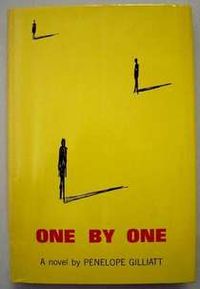
  • one by one

    One by One by Penelope Gilliatt (Atheneum, 1965)

    Another brilliant book by Gilliatt, set in the environs of London during a mysterious plague-like epidemic that is killing thousands of people.  Roger, a veterinarian, volunteers to work in inner-city clinics while his almost full-term pregnant wife Polly frets and tries to cope in the suburbs.  Assorted other interesting secondary characters, including Roger’s hateful mother, and Corker, his best friend and former lover.  This is Gilliatt’s first novel;  despite the familiar premise, it is well sustained and originally conceived and executed.  Very smart and insightful about love, marriage, and homosexuality.  An excellent book.

    One_by1-210-exp

  • the limit

    The Limit by Ada Leverson(Chapman & Hall, 1911)

    Very funny and charming British novel written c. 1910 about the marriage and affairs of a group of nicely drawn and entertaining characters.  Valentina is married to Romer but also loves her cousin Henry, who is engaged to a huge girl named Alex who is an heiress and plays field hockey.  Meanwhile, Van Buren, a wealthy dull American courts Valentina’s younger sister, Daphne, who is engaged to the indigent, simple, but beautiful Cyril, a guardsman.  Several mothers and assorted friends complete the milieu.  Leverson was a friend and supporter of Oscar Wilde, and much of this book reminds one of Wilde: the silliness that floats atop an underlying melancholy; the absurd, delightful and epigrammatic dialogue; and the Edwardian details.  A minor book, surely, but a delightful one.  Perhaps a tad under sustained, but not seriously marred by that one minor fault.

  • the bay of noon

    The Bay of Noon by Shirley Hazzard (Little, Brown, 1970)

    220px-TheBayOfNoon

    I have always remembered this book as being good but somewhat inferior to The Evening of the Holiday, and perhaps it is not as exactly and perfectly etched as that book, but this re-reading after thirty years struck me very deeply (perhaps because I have just returned from Naples?).  A young British woman named Jennie narrates the book.  She spent the war in South Africa and returns to London only to leave again, this time to Naples where her fluency in Italian and secretarial skills find her employment with an international military commission developing a report on fishing or some such maritime subject.  A letter of introduction brings her to Giaconda, a beautiful Italian woman about ten years older who is having an affair with Gianni, a charming and handsome film director who is older still.  Jennie becomes close friends with Giaconda, and a sort of third wheel to her and Gianni’s affair, while pursuing a dry and cerebral flirtation of her own with Justin, a Scottish biologist.  Over the course of a year, these four characters come together and apart in surprising ways.  Hazzard’s prose is dense with similes and metaphors, and burrows intimately into the story only to pull back, or flash forward, altering the perspective.  Jennie is, perhaps, wise beyond her years and experience, and Giaconda and Gianni are both given to profound and oracular statements.  But the grace and elegance and lightness of the prose allows all of the observations to float, and the book is buoyed, rather than weighted, by Hazzard’s intelligence.  A rare, beautiful, intelligent book.  I’m very happy that I read it again.

  • sentimental education

    Sentimental Education by Gustave Flaubert (Penguin Classics, 1964)

    I had tried to read this book several years ago, but had not gotten beyond the opening pages.  This time I persevered and made it through.  It’s a difficult book, very full of character and event but with very little narrative momentum or shape.  And most of the characters, including our hero Frederick Moreau, are flawed and not very sympathetic, and don’t learn much or change or mature over the long course of the book.  What kept me reading was the beauty and vividness of Flaubert’s prose.  The descriptions of clothes, interiors, landscapes — everything, really — are so good and so pleasurable to read that one continues reading merely to remain within the dazzling world of the book.  Sentimental Education lacks the perfect succinctness and coherence of Madame Bovary, but it is not without somewhat shaggy charms and pleasures of its own.

    Flaubert-sentimental