The publisher and date listed always refer to the edition of the book that I read; illustrations are chosen for the graphic appeal and may not correspond to the edition that is cited. Photographs are always of the author (unless otherwise indicated).
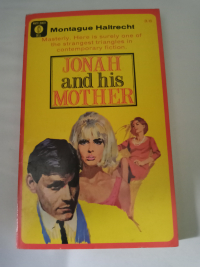
Jonah and His Mother by Montague Haltrecht (Andre Deutsch, 1964)
This is the second novel of Montague Haltrecht that I’ve read (see A Secondary Character, below) and I think he’s an interesting and talented queer writer from the pre-Stonewall era. This book, with its focus on the toxic and perverse relationships between mothers and (perhaps) homosexual sons and the gothic horror therein, reminded me at times of Tennessee Williams.
Federika has lived parasitically off of wealthy men, using her beauty and glamour to ensnare them and then proceed to exploit them financially before moving on. When this book begins, she is living on fumes in a hotel with her beautiful 17-year-old son, Jonah. One evening, they go to the opera at Covent Garden, which has always proved to be a happy hunting ground for Federika (she likes her men wealthy and cultured), and this evening is no exception. At the first interval they meet Gray, a prosperous looking middle-aged gentleman, and Federika flirts with him until she realizes he is more interested in her beautiful son. Being a practical woman, she encourages this attention although she is a bit shaken not to be the object of desire — is she getting old, losing her market value? Yes.
Gray takes Jonah home and into his bed but Federika soon joins their menage as a sort of housemother. Jonah, who does not enjoy the time he spends in bed with Gray, becomes acquainted with a young woman who lives in their building and who sells hats at Harrods (does anyone still wear a hat?). He begins to court her, ineptly, with Gray’s reluctant permission, as Gray realizes clutching Jonah will only hasten his inevitable departure. The novel follows the decline and dissolution of all these relationships, except for Jonah and his mother, who, in the final scene, are back at the opera seeking new prey, with Jonah having unquestionably replaced his mother as the bait.
Haltrecht is a good writer, able to create vivid and interesting characters and make lively scenes with amusing dialogue. This is a slim, inconsequential book, but I enjoyed reading it.
A Summons to Memphis by Peter Taylor (Knopf, 1986)
Peter Taylor is a gentle, accomplished writer, but this book bemused and often irritated me. I think part of the problem may be that Taylor is not a natural or adroit novelist; this book is very oddly (and ineptly) paced and structured. It moves slowly, if at all, like those traveling sprinklers that never seem to be moving yet eventually traverse a lawn.
A Summons to Memphis is narrated in first person by Philip Carver, a bland middle-aged man who lives in New York City and works as a rare book dealer and editor, but we never hear much about his life’s work and he expresses very little interest in or passion for books. He expresses very little interest in or passion for anything, perhaps because when he was 13 his father, due to a cataclysmic business failure caused by his partner, uprooted his family from their idyllic life in Nashville and moved them to Memphis, which had mysteriously disastrous effects on all the family members: Philip’s mother lost her Nashville grace and poise and became a chronic invalid and recluse; his two sisters, Josephine and Betsy, were forced into spinsterhood when their father sabotaged both their engagements; Georgie, his brother, was killed in WWII; and Philip’s own great love with a young woman named Carla Price was also brutally (and inexplicably) terminated by his father, who was the only Carver to thrive in their new life in Memphis. (Philip escaped to New York City where he now lives with a younger woman in a static, unsatisfying relationship that seems tepid at best.)
The present action of the book, such as it is, revolves around the elder Mr. Carver’s attempt to marry after his wife dies and leaves him a widower in his 80s. The two sisters summon Philip to Memphis and enlist him in thwarting their father’s matrimonial plans, an ugly act that seems part revenge and part safeguarding their inheritance. But this potential conflict is resolved off-page with no drama, and the book’s denouement is equally bloodless and inscrutable.
All these seemingly genteel people act ruthlessly to destroy one another’s happiness, but it is never clear what motivates all this bad behavior or what satisfaction, if any, it affords. So a very puzzling book — somewhat Chekhovian in its minor-key uneventfulness, but lacking Chekhov’s resonance and mysterious, beautiful, and heartbreaking, depth. The reader is barely involved, let alone moved.
Out with the Stars by James Purdy (Peter Owen, 1992)
Another strange — of course — book by James Purdy, and although it has all the usual Purdian qualities, it seems a bit forced and haphazard. It’s set in New York City in 1965, and concerns itself with a number of homosexual artists, mostly composers, photographers, actors — some ancient, some striplings.
What little plot there is revolves around the world premiere of Abner Blossom’s opera Cock Crow, which is based on the life of Cyril Vane, whose life-long passion and work was photographing and fetishizing naked Black men. Cyril’s Russian silent-movie-star wife, who is incensed by her husband’s proclivities and jealous of the attention he pays to men, vows to prevent the opera from opening, and much unbelievable drama ensues.
Purdy seems to let the book go wherever it likes; it has no discernible structure or shape, but then one doesn’t read Purdy for those things. Yet a certain magical resonance is missing in Out with the Stars — too often Purdy seems to be on autopilot — it’s like a complicated gourmet recipe copied by a not-fully-informed chef, who omits several key yet secret ingredients, and produces a dish that is comestible rather than delicious.
The Moon and Sixpence by W. Somerset Maugham (Modern Library, 1919)
The Moon and Sixpence (the intriguing title is never explained or mentioned in the book itself) is a novel inspired by the life Paul Gauguin. In Maugham’s version, he’s Charles Strickland and English, a well-to-do businessman in London who abruptly and mysteriously abandons his wife and two children and moves to Paris to paint, although he’s never shown any interest in painting and has no training and apparently not much talent.
Today Strickland would be considered to be “on the spectrum” and closer to one end than to the other. He is devoid of sympathy and empathy, thinks only of himself, and is impervious to any and all creature comforts. The book is narrated by an acquaintance of Strickland’s who met him briefly when he still lived in London, became quite involved in Strickland’s life while they were both living in Paris, and just happens to be in Tahiti shortly after Strickland’s death there so that he can learn all about Strickland’s final chapter from witnesses and participants.
Maugham is a skilled and adroit writer, and this book is engaging, but all the characters, with the exception of Strickland’s abandoned wife, who is interestingly alive and surprising, are one-dimensional and exaggerated. And here is yet another book that is narrated by a man who is very apparently homosexual, yet never alludes to his romantic or sexual life, thus negating himself as a character.
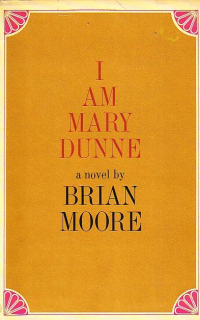
I Am Mary Dunne by Brian Moore (Viking Press, 1968)
An odd book, both brave and foolish, that begins promisingly and then slowly deteriorates into tedious melodrama.
Mary Dunne grew up in a small village in Nova Scotia and got away as quickly as she could by eloping with a high school friend who just happened to have a ticket out. She ends up, after two more marriages, living the high life in 1960s New York: married to a nice, sexy British playwright and man-about-town, living in a two-bedroom apartment on the Upper East Side, lunching with friends, drinking, and feeling hysterically depressed — perhaps because she’s about to have her period or perhaps because she’s crazy and suicidal. So during a long NYC day she reviews her entire life for her own (but mostly the reader’s) benefit: her attempts to be a writer and an actress, her mostly disastrous marriages. The frequent shifts between the past and the present are often unwelcome, and the reader feels tugged around. Moore is a skillful writer but despite his extensive examination of his character’s gynecological and sexual experiences, Mary Dunne remains rather fake: distant and unlikeable, and the microscopic attention that this book pays to her begins to seem unwarranted, and finally rather boring.
The Polyglots by William Gerhardie (Prion Books, 2011)
Another odd, beguiling book by this unique and interesting writer. The Polyglots (originally published in 1925) is set in the far east — mostly in Japan and China during the period of the Great War and the Russian Revolution.
Its narrator is a British military man of Belgian descent, born in Russia, who is posted rather autonomously, it seems, in the far east, where he reunites with his eccentric Aunt ? and lives with her very large, very eccentric family which includes many hanger-ons. All these people, whether French, Belgian, British, or Russian are outcasts, waifs, people once firmly ensconced in empires or regimes that have failed or are floundering. So they go on living as best they can on ever-diminishing resources and finances, unable, until the very last moment, to give it all up and head for home — a home that is theirs only geopolitically, not sentimentally.
The narrator falls in love with Aunt ?’s beautiful and decorative but pathetically vacant daughter. Their inert romance, and the family’s necessary removal from Tokyo to Harbin, China via Vladivlastock, is as much of a plot as Gerhardie can muster, but the real strength and charm of this book is its gallery of eccentrically poignant characters and its wonderfully strange atmospheres — a world that is vanishing so quickly that at times it seems already lost.
Bachelor’s Hall by Reginald Underwood (The Fortune Press, 1937)
Bachelor’s Hall is one of the many queer books the Fortune Press published in the first half of the 20th-century. It’s an odd, singular book because its ideas about homosexuality seem very strange and dated, as does the world of the book, ostensibly set in the 1920s, after the Great War. It seems much more like a 19th-century world — perhaps because it is set entirely in a small, rural English village that seems years behind the times.
Adrian Byfield is our interesting hero. He is a bastard or perhaps the legitimate product of his mother’s first, brief, secret marriage, but grows up believing he shares a father with his two younger brothers, although he shares nothing else with them: from an early age he is disgusted with the idea of physical love, hates women, and longs for a “pure” romantic friendship with a male friend. He finally finds this with Ronald, a sweet lovely boy a few years younger than Adrian. They love and admire one another, but eventually it becomes clear that Ronald’s love isn’t as pure as Adrian’s: he has carnal desires for his beloved friend, which disgust Adrian, whose cruel abandonment drives poor Ronald to suicide. The book ends with Adrian, devastated by the loss of his friend, perhaps understanding that love can possibly be physically manifested and expressed.
An odd subplot has Adrian being pursued by a local woman who is ten years older. When she finally realizes that Adrian is not the marrying (or fucking) type, she gets pregnant by an evil married doctor and secretly gives birth prematurely to a ghoulishly deformed baby she kills and throws down an old well.
Asexuality seems to be the ideal in this book, and procreative heterosexual sex is seen as being animalistic and crude. Of course Adrian’s fear and loathing of all kinds of sexual intimacy seems to be a product of his total homosexual repression.
The Promise by Damon Galgut (Europa Editions, 2021)
Galgut is a writer I very much enjoy and admire. His books are smart and odd and challenging. The Promise is perhaps the most conventional of the ones I have read (which I think is all), but I liked it very much.
It’s the story of white middle-class family living on a farm outside of Pretoria in the late 20th and early 21st centuries. The novel is divided into four sections, each set about ten years apart, and each section centers around the death and burial of a family member: the mother, the father, the brother, and the older sister, leaving only the younger sister, Amor, alive at the end of the book.
She is the most interesting character in the book — perhaps because she’s the most mysterious — but all the characters are complex and engaging. The novel obliquely reveals the death, rebirth, and swift deterioration of South Africa before, during, and after the end of apartheid.
A conversation I had with Damon Galgut about the book can be accessed at this link. It was hosted by Lambda Literary and Europa Editions.
A Secondary Character by Montague Haltrecht (Andre Deutsch, 1965)
An odd, slight, generally unappealing novel.
Christopher, our (anti-) hero, is a young homosexual man, who has been raised in the most repressive and thwarting conditions of post-war England. His mother is a monster of misguided propriety and hate and fear, and tries to control every aspect of her son’s life in fear that he might act naturally and embarrass her. Shortly after Christopher manages to move out of his parents’ suburban prison into a rooming house in London, his mother kills herself and leaves Christopher a small legacy. He takes the money and runs to a small town on the Mediterranean where he begins a tortured relationship with Leon, a manipulative and abusive gay man. They live together unhappily, and then Leon bolts, owing Christopher lots of money. Christopher picks up a local boy, beats him to death, then kills himself by drowning in the sea.
Nothing in this book quite works. The most engaging character is the monstrous mother, but she is dispatched early on, and the book suffers from her absence. A curious but unsuccessful book. Jonah and his Mother, Haltrecht’s first book, is superior in just about every way.
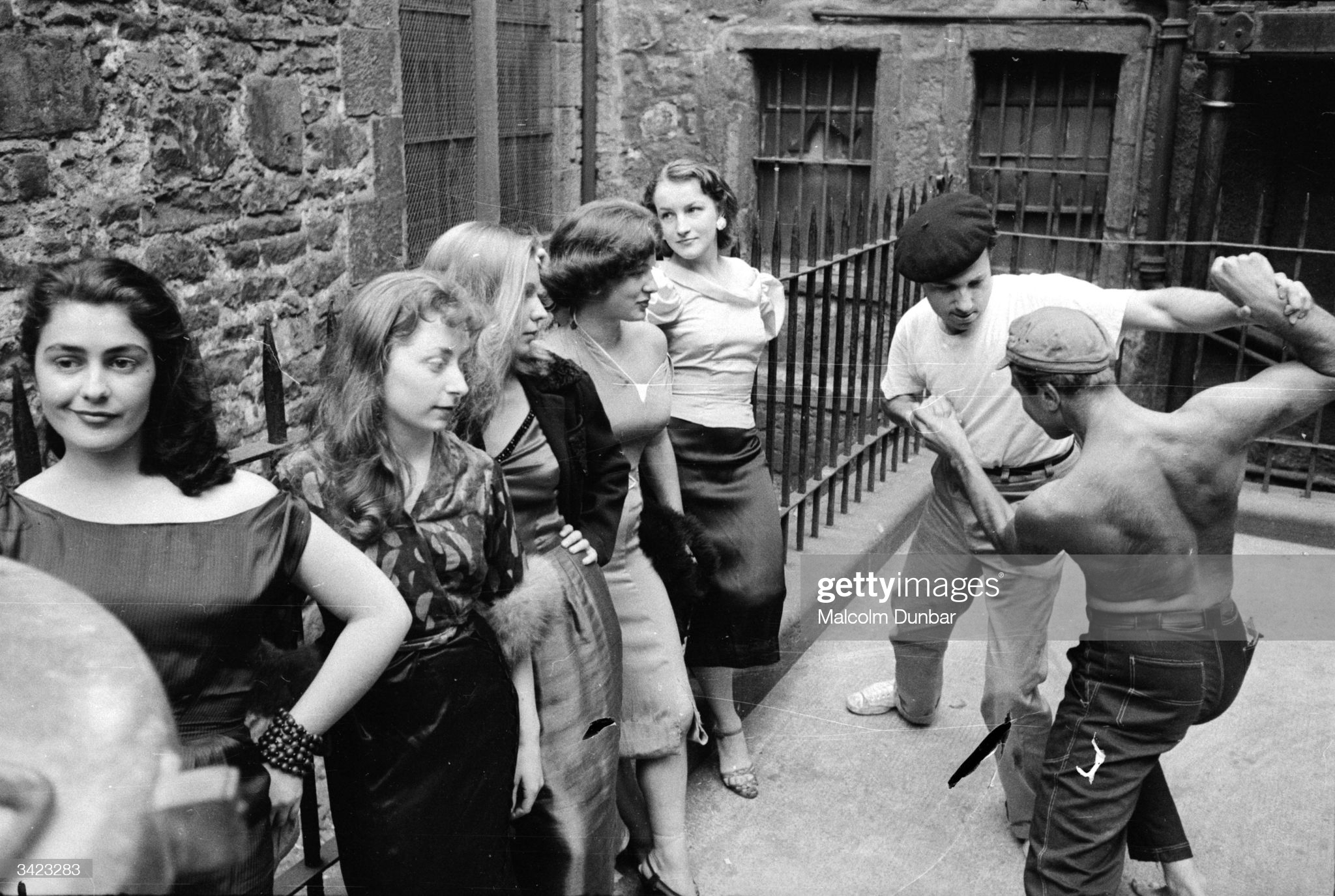
19th September 1955: Stripped to the waist, Montague Haltrecht rehearses his piece for the Edinburgh Festival with Rod Robertson. Original Publication: Picture Post – 7989 – Bohemians Of The Royal Mile – pub. 1955 (Photo by Malcolm Dunbar/Picture Post/Hulton Archive/Getty Images)
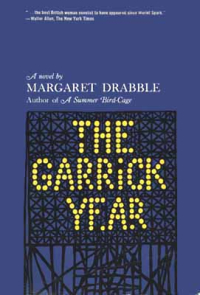
The Garrick Year by Margaret Drabble (William Morrow, 1965)
I believe I first read this book in 1979, during my first year at Hamilton College, in Elaine Hansen’s Modern Women Writers class. We also read (I think) Jerusalem The Golden, A Summer Bird Cage, The Millstone, and The Waterfall (along with Tell Me a Riddle by Tillie Olsen and The Edible Woman by Margaret Atwood) and I remember loving these early Drabble novels and admiring them for their focus on the intimate lives of young women during a time when women’s lives were changing. A few weeks ago, when I emptied my bookshelves in order to install new floor-to-ceiling shelves, The Garrick Year ended up on top of one of the many piles I had placed on the floor, and so when I was looking for a book to read, there it was, and I thought it would be interesting to read it again 40 years later.
It was interesting: this is Drabble’s second novel, (following A Summer Bird Cage). It’s the story of Emma, a bright and beautiful woman who is married to a charismatic and sexy Welsh actor, David. They have two children: Flora, who’s 3 or 4 years old, and Joe, who is a baby. The Garrick Year takes place during the spring and summer in an early ’60s year, and is mostly set in Hereford, a small town near the Welsh border where an eccentric American woman has funded a new regional theatre, and David is hired as one of the company that will inaugurate the theatre with a season of three plays presented in repertory.
So Emma, David, and the children leave London (where Emma had just been offered a fabulous job as a news reader on TV, which the move requires she sacrifices) for Hereford, where they rent a house in the village. Emma begins an affair with the director of the company, an older, rather pompous gentleman, who intrigues Emma but whom she doesn’t find sexy, so she and her lover spend most of their time together motoring around the countryside in his Jaguar and having meals in restaurants, where Emma habitually orders several appetizers rather than an entree, flirting with him but not encouraging his physical advances. Meanwhile, unbeknownst to her, David is having an affair with Sophie Brent, the youngest and least talented actor in the company, but the most beautiful.
Emma is a smart and engaging narrator, but she isn’t very sympathetic. She’s selfish, entitled, rude, lazy, and her behavior with the director (what’s his name? Farquhar or some other pretentious English surname) becomes tiresome and boring. So there isn’t much narrative momentum in the middle third of the book, and I felt my interest steadily declining. As if sensing this, in the book’s final third, Drabble suddenly overcompensates for the lack of action heretofore with a plane crash, a near drowning, and a car accident, all of which shock the plot into concluding rather hurriedly and easily.
But in the last few pages, as Emma looks back over the events of the summer and draws conclusions about her own and other’s behavior, the writing takes on a complexity and polish that transcends the floundering narrative and the book ends on a rich and wise grace note, which is, I think, indicative of the complexity, beauty, and wisdom of the books Drabble would soon write: The Needle’s Eye, Jerusalem the Golden, The Waterfall.
Paul Newman reads Margaret Drabble’s The Garrick Year


 A young James Purdy


 Paul Newman reads Margaret Drabble’s The Garrick Year